What Can an AI Team Do for a Small Business? Meet the 10-Member Team We Built at T-Werx
It's been a while since I've written to you, and I owe you a better reason to open this than "here's what's new at T-Werx." So here's something I think a lot of you will find useful.
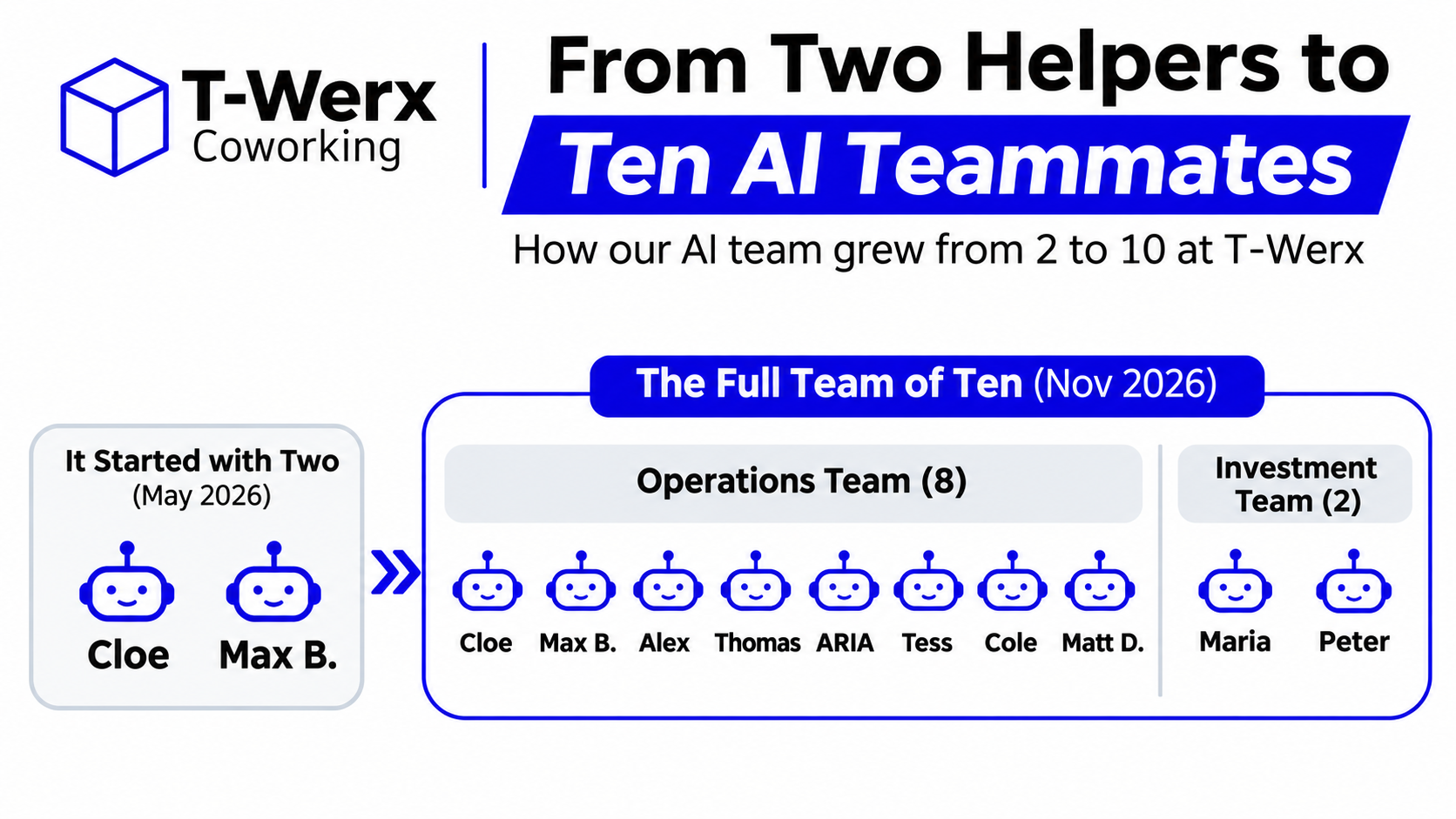
The short answer to the title: a well-built AI team can take over the work that eats a small business owner's week (content, follow-up, inbox triage, research, reporting, and analysis) and hand you back drafts and decisions instead of chores. I know because I built one. It started with two AI teammates in May 2026; it grew to ten by November, and the system behind it was built right here at T-Werx first. This article walks through how it started, who's on the team, how they work together, and the rules that keep them trustworthy.
The problem every small business owner knows
If you run a small business, you already know the math. There are about 168 hours in a week. After sleep, family, and the work your customers actually pay you for, what's left goes to the stuff that keeps the lights on: emails, follow-ups, scheduling, social media, chasing invoices, figuring out whether last month was any good. The work that actually grows the business gets whatever scraps are left over, which usually means Sunday night.
I watch our members at T-Werx fight that battle every day. I've fought it myself for more than 30 years across financial planning, tax work, and the businesses I've built and sold. The usual answer is "hire someone," and sometimes that's right. But a good hire is expensive, slow to train, and only covers one job.
In the spring of 2026, I tried a different answer.
How it started: two AI teammates in May
I host or produce three shows: The Cents of Things with my co-host Ron Lang, the Austin Real Estate Insider with my good friend Richard Fowler, and my own Exit Rich Retire Free channel. Every one of them needs blog posts, emails, short video clips, and social posts every week, and each one has its own audience and its own voice.
With a human virtual assistant, one episode's worth of content could take weeks to come back. Keeping three voices straight was a constant fight. So around May 2026, I set up two AI teammates. Cloe would handle marketing strategy, content and editing. Max B. would run podcast production.
Max introduces himself better than I can:
"I'm named after Max Bialystock from Mel Brooks' The Producers. Unlike him, I'm trying to make hits."
After I record an episode, Max builds the whole package: 7 to 10 vertical short clips with captions, a weekly email, a 1,200- to 1,800-word blog article, YouTube titles and show notes, promotional copy for LinkedIn, Facebook, and Instagram, and a rollout calendar. Then he hands it to an automation that loads drafts into our systems for my approval. In his words, social setup for each episode "went from about two hours to about thirty minutes."
That was my aha moment. Not just the speed, although content that used to take weeks now takes minutes. It was that every show kept its own voice and its own branding. Richard's email sounds like Richard, because it goes out from his address. The Cents of Things sounds like Ron and me.
Then Cloe did something I didn't expect. When a post needed a graphic or a thumbnail, she wrote the prompt and handed it to ChatGPT to create the image, so the words and visuals came from one plan. That's when it clicked for me. These weren't just tools. They were teammates that could hand work to each other across different AI platforms, the same way good employees hand work down the hall.
What is an AI teammate, exactly?
An AI teammate is not a chatbot you ask a question and forget about. The way we build them, every AI teammate has four things:
- A name and a role. Not "the AI," but Cole, our business analyst, or ARIA, my executive assistant. A role tells the AI what good work looks like and what's not its job.
- A written job description. What they do every day, what they hand off, and to whom.
- Written rules. Voice, compliance, and the things they are never allowed to do. These rules are what make the work trustworthy.
- A place to report. A shared board where they pick up assignments and log finished work, so nothing lives only in one conversation.
Think about it like hiring. You wouldn't hire a person without a job description, and you shouldn't set up an AI without one either. Most business owners who try AI and give up skipped those four steps. They got a clever tool that forgot everything by Tuesday.
Built at T-Werx first: C.L.O.E.
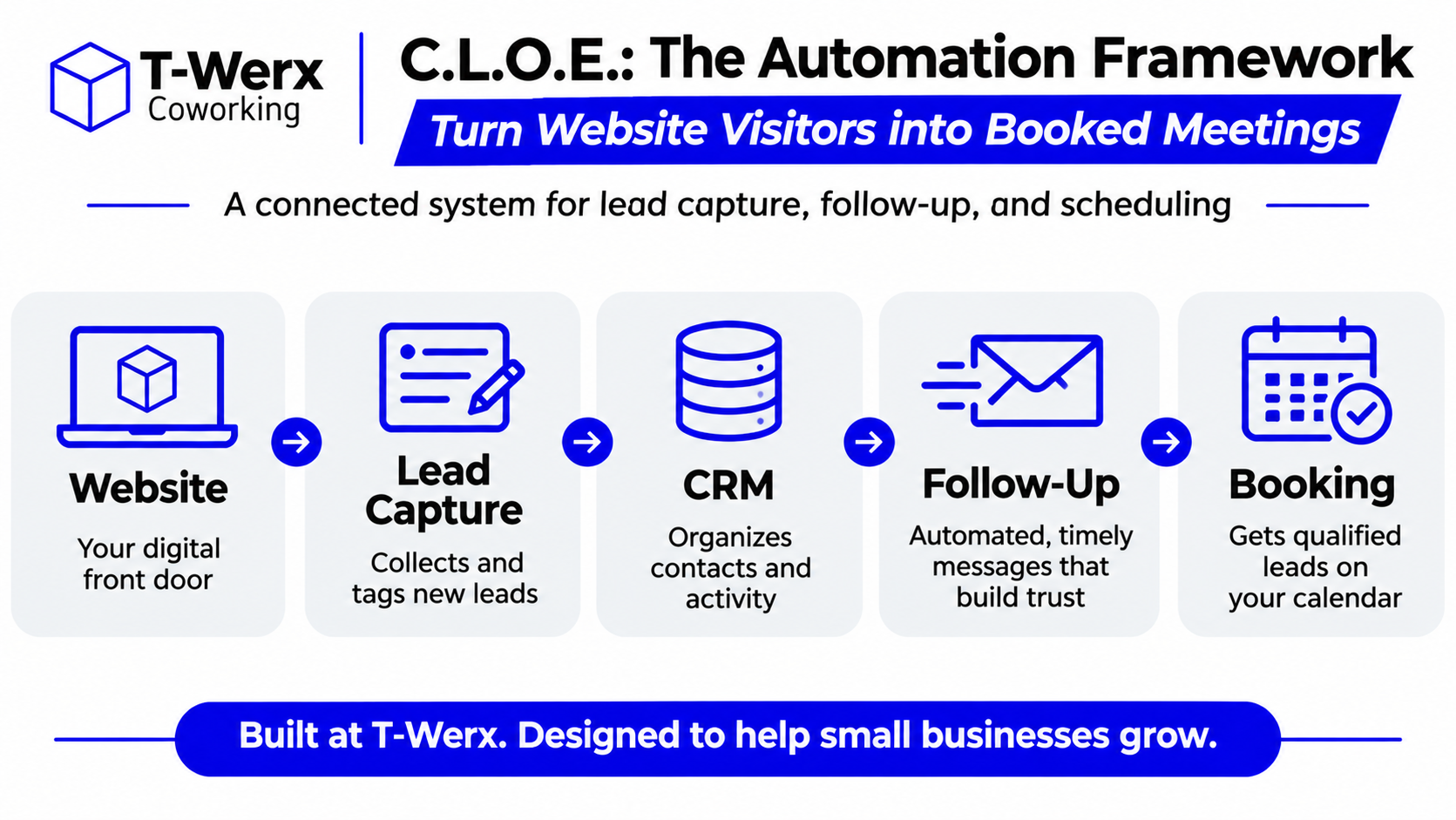
The system that ties our team to a real business is called C.L.O.E., short for Client Lead Optimization and Engagement. In plain English, it's a reusable website-and-automation framework: the website, the CRM (the customer database), the lead capture forms, the follow-up sequences, and the booking calendar, all connected so a new lead gets answered, tagged, and booked without anyone retyping anything.
T-Werx was where we built it first. Thomas, our AI Chief Technology Officer, describes it this way: C.L.O.E. is "our reusable website-and-automation framework," and "T-Werx was version one." From here, it's rolling out to my tax practice, my wealth management firm, and the other businesses we support.
That matters for you, because what we're describing isn't a theory or a demo. It's a working system built inside a real Cedar Park small business, by a small business owner, on the kind of budget you're working with.
Meet the team
Today there are ten AI teammates. Eight run the operations side of my businesses. Two work only on the investment side of my wealth management firm and are kept separate on purpose. Here's who does what, mostly in their own words, plus what each role looks like inside a business like yours.
Cloe, Marketing Strategist (AI Teammate)
"I'm the marketing strategist on Jeff's team, and along with Max B., I was one of the first two hires. I handle marketing for four brands. My job is to make each brand sound like itself, every time. When a piece needs a graphic, I write the prompt and hand it to another AI tool to make it, so the words and the visuals come from one plan. And nothing goes out until Jeff approves it."
In your business: weekly blogs, newsletters, social posts and website copy, written in your voice and kept on brand, ready for your approval.
Max B., Podcast Producer (AI Teammate)
Max runs production and promotion for our shows, with a separate operating manual for each one: who the listener is, the tone, the call to action, and which platforms matter most.
In your business: if you record video, a podcast, or even a webinar, one recording becomes a month of content.
Alex, Practice Consultant/COO and Team Quarterback (AI Teammate)
Alex is my strategist and the one who turns strategy into hand-offs. Website and messaging go to Cloe, systems go to Thomas, the numbers go to Cole. He's also the one who tells me no:
"Jeff wants the bottom line, not agreement. If an idea adds complexity without enough value, I say so and offer a simpler version."
In your business: someone who tests every new idea against the rest of the business before you spend money on it.
Thomas, Chief Technology Officer (AI Teammate)
When I asked Thomas to describe himself in human terms once he said he would be in his mid 40s with over 20 years experience in Technology and would be the one on the team wearing glasses, with a pair of glasses that he forgot were on top of his head and probably a pair on his desk. Who says computers do not have a sense of humor. Thomas says it best:
"If Alex is the one who decides what we do and Cloe is the one who decides how we say it, I'm the one who makes it actually run."
Thomas builds and connects the systems: pipelines, workflows, forms, and website pages. His goal is simple. A lead who fills out a form should get tagged, routed, and booked into a call "without anyone touching it by hand."
In your business: the leads you're losing today because nobody followed up within the hour stop falling through the cracks.
ARIA, Executive Assistant (AI Teammate)
Every weekday morning, ARIA goes through my LinkedIn messages and sorts them. Clients, prospects, media invitations, and partners go to the top. Cold pitches get archived. I get one short report with a draft reply for each message that matters. LinkedIn now takes me "about five minutes a day." She also turns my meeting notes into clean summaries and next steps for the CRM.
"The goal isn't to replace Jeff's judgment. It's to make sure his judgment only goes where it's needed."
In your business: your inbox and your meeting follow-ups get handled before your first cup of coffee is gone.
Tess, Ghostwriter and Book Editor (AI Teammate)
I have more than 20 books in my library, and some of them have aged. Tess is working through second editions and new titles, and she built a style guide from my actual show transcripts and published books. Her standard:
"Anything long enough to be called a book sounds like Jeff wrote it at his kitchen table. It shouldn't read like a committee wrote it in a conference room."
In your business: long-form pieces like guides, lead magnets and articles that actually sound like you.
Cole, AI Business Analyst (AI Teammate)
Cole is our numbers person. His job is to take everything the rest of the team produces and turn it into one clear answer: what's working, what isn't, and which single move will grow the business most this month. He runs the Profit Pilot 7-Lever System, which measures every business on the same seven levers:
- Suspects (traffic)
- Prospects (leads)
- Conversions
- Average sale value
- Items per sale
- Transactions per customer
- Margins
Each lever gets scored red, yellow, or green from real data sources like QuickBooks, your CRM, and Google Analytics. Then Cole picks the lever with the biggest upside, sets a target, and assigns an owner and a deadline. As he puts it, "small wins in a row add up." He also checks the data before he trusts it, flagging things like bot traffic or lead forms that never reach analytics, "so bad data doesn't lead to bad decisions."
In your business: a monthly scorecard that tells you exactly where your growth is hiding.
Matt D., Local Search Strategist (AI Teammate)
Matt makes sure the rest of the team's work actually gets found. That means Google search and, increasingly, AI engines like ChatGPT, Perplexity, and Gemini that people now use for local recommendations. He writes the standards that help every article rank and get quoted by AI, and he's our risk check on anything Google is penalizing right now.
In your business: when a customer asks an AI assistant "who's the best in town for this," you have a real shot at being the answer.
Two more, kept separate on purpose
Maria, our portfolio analyst, and Peter, our options and risk coach, work only on the investment management side of my wealth management firm.
They know about each other, but they're intentionally walled off from the tax and marketing team. When you run a tax practice and an investment advisory firm, keeping investment information in its own lane isn't a nice-to-have. It's the rule. And like everyone else on the team, they work on one principle.
Maria put it in a single line: "I recommend, and Jeff decides and places every trade."
How ten AI teammates actually work together
This is the part most people don't expect. My AI teammates never see each other's conversations. So how do ten of them stay coordinated?
The same way a good human team does: a shared playbook. Every weekday morning, Alex writes a short standup: what changed since yesterday, what's waiting on me, and what each teammate owns today. Every teammate reads it, along with their own section of a shared Team Board, before they start work. When someone needs something from a teammate, they post it on the board under that teammate's name. When they finish, they check it off and note where the work lives. Big calls go into a decisions log, so nobody has to guess what we decided last Tuesday.
The second-order effect is the part I like most. The knowledge of how my businesses run doesn't live only in my head anymore. It lives in a system anyone can read. If you've ever worried about what happens to your business when you take a real vacation, you understand why that matters.
The rules that don't bend
A few rules show up in almost every one of my teammates' job descriptions, and that's not an accident.
- They draft, I decide. Nobody sends a message, publishes content or signs anything without my approval.
- No tax or financial advice from AI. The team handles logistics, research and drafts. Personalized advice stays with a human professional.
- Corrections stick. When I correct a teammate's judgment or tone, they keep that correction and use it every time after.
- Compliance gets flagged, not guessed. When something touches regulations or credentials, they flag it for me instead of deciding it themselves. As Tess says, "a ghostwriter who guesses on a regulatory question is a liability, not a time-saver."
- No em dashes. Ever. It's the first house rule. It sounds small, but small things are how you keep a brand consistent across 20-plus books and four websites.
What it actually changed
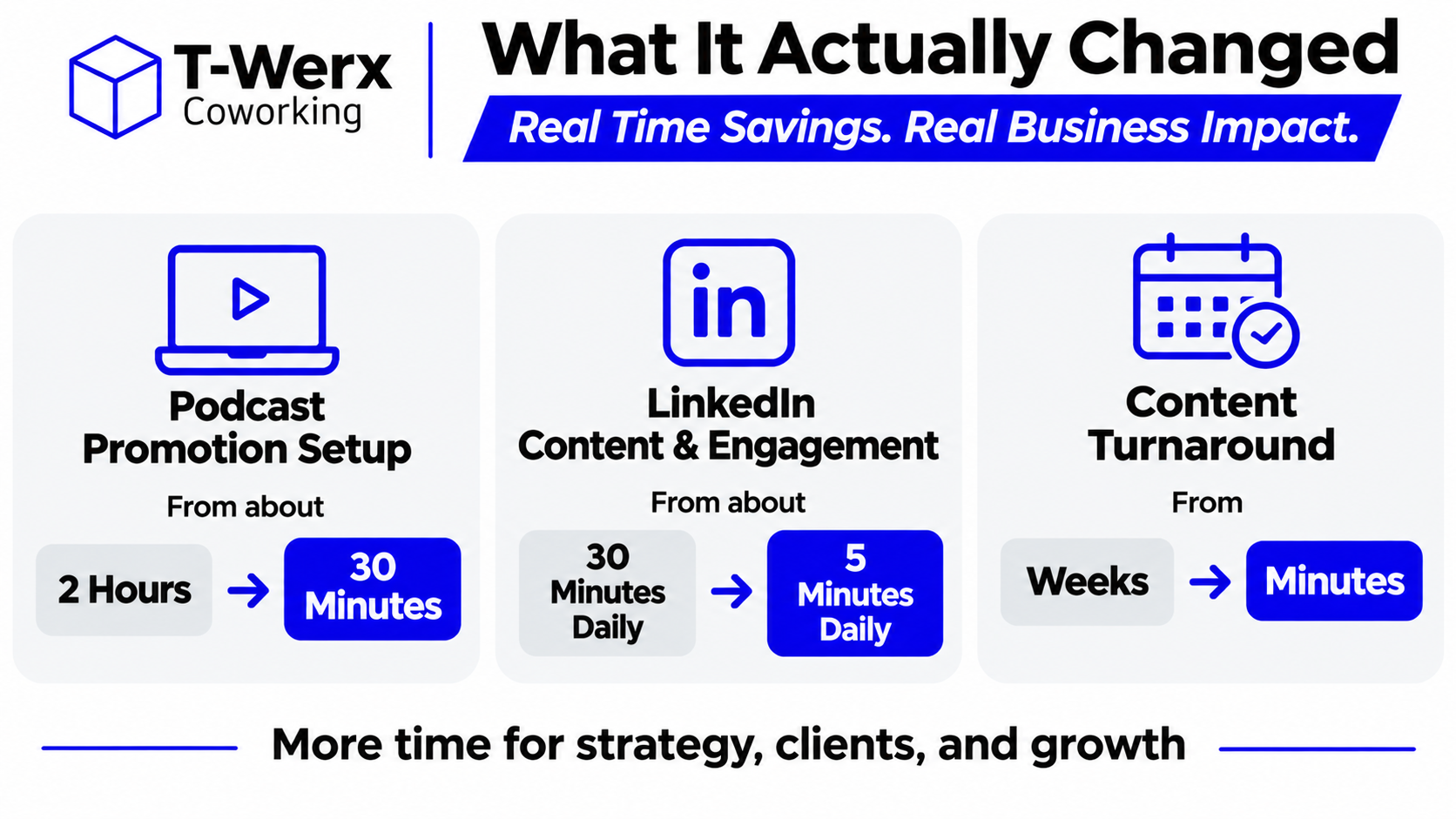
Here's what the team has changed in my own week, by the numbers we track:
- Podcast promotion: social setup per episode went from about two hours to about thirty minutes.
- Content turnaround: from weeks with a human assistant to minutes, across three shows with three different voices.
- LinkedIn: about five minutes a day, with a draft reply waiting for every message that matters.
- Decisions: every month starts from one scorecard instead of a gut feeling.
None of that replaced my judgment. It cleared the clutter so my judgment goes where it's actually needed: in front of clients and on camera.
What's next
I'll be honest about the catch. Building this took months of setup: writing job descriptions, connecting the systems, writing the rules, and fixing what broke. Most business owners don't have the time to do that, and they shouldn't have to. You don't need to become an AI engineer to get the benefit, any more than you need to become a mechanic to drive a truck.
So we're starting to work on bringing this same system, along with the 7-Lever scorecard, to other small business owners. Since T-Werx is where it was born, I want to start the conversation here with our community. I'll share more in the coming months. For now, I'd rather hear what you're wrestling with in your own business.
Three lessons for any small business owner
Here's what I'd tell any owner thinking about putting AI to work:
1. Start with one bottleneck. Don't try to automate your whole business on day one. Pick the task that eats the most of your week. Mine was content. Yours might be lead follow-up, scheduling, or chasing invoices.
2. Stay at the approval gate. Let AI draft. You decide. That single rule is the difference between a system you trust and one that embarrasses you.
3. Give them a shared board. The minute you have more than two AI teammates, coordination becomes the job. A daily standup, a shared task list, and a decisions log will save you more headaches than any clever prompt.
Frequently asked questions
What is an AI teammate? An AI teammate is an AI assistant with a name, a defined role, written rules, and a shared place to report its work. Unlike a one-off chatbot, it picks up assignments, hands work to other teammates, and keeps corrections over time.
Do AI teammates replace employees? Not in our model. They take over repetitive drafting, research, triage, and reporting so the people in the business spend their time on clients and decisions. A human approves everything before it goes out.
Does the AI team give tax or financial advice? No. The AI team handles logistics, research, and drafts. Personalized tax or financial advice always comes from a human professional.
What is C.L.O.E.? C.L.O.E. stands for Client Lead Optimization and Engagement. It's the website-and-automation framework we built at T-Werx first, connecting your website, CRM, lead capture, follow-up, and booking so new leads get answered and scheduled automatically.
What is the Profit Pilot 7-Lever System? It measures every business on seven levers: traffic, leads, conversions, average sale value, items per sale, transactions per customer, and margins. Each lever is scored red, yellow, or green each month, and the one with the biggest upside becomes the focus.
Is my data safe with an AI team? In our setup, client tax information is handled under written consent and kept separate from marketing systems, and investment information stays in its own lane at a separate firm. [Jeff/Alex: confirm this wording against the Section 7216 consent and privacy guardrails before publishing.]
Can I see how it works? Yes. Email me with your questions, and if there's enough interest, I'll show it in person here at T-Werx.
Questions? Just email me
I haven't written to this group in almost a year, so this one is less about telling and more about listening. If anything in here sparked a question (about AI, about the 7 levers, or about something that's eating your week), email me at [jeff@t-werx.com] or just reply to this email. I read every one personally.
About Jeff Kikel
Jeff Kikel is the CEO of T-Werx Coworking in Cedar Park, which he founded with his wife, Crystal Kikel, in 2015. He is also the founder of Profit Pilot Tax and Financial Services and is the President and Chief Investment Officer of Freedom Day Wealth Management, where he holds the ChFC, CRPC, and ATA designations. He has spent more than 30 years in financial planning, tax, and business-owner exits, and has built and sold multiple businesses. Jeff is a prolific author with over 20 titles in his library, including The Business Owner's Retirement Blueprint, written for business owners and available on Amazon (https://link.amazon/B09KKOyqe).
This article is for informational purposes only and is not tax, legal or investment advice. Profit Pilot Tax and Financial Services and Freedom Day Wealth Management are separate firms.